
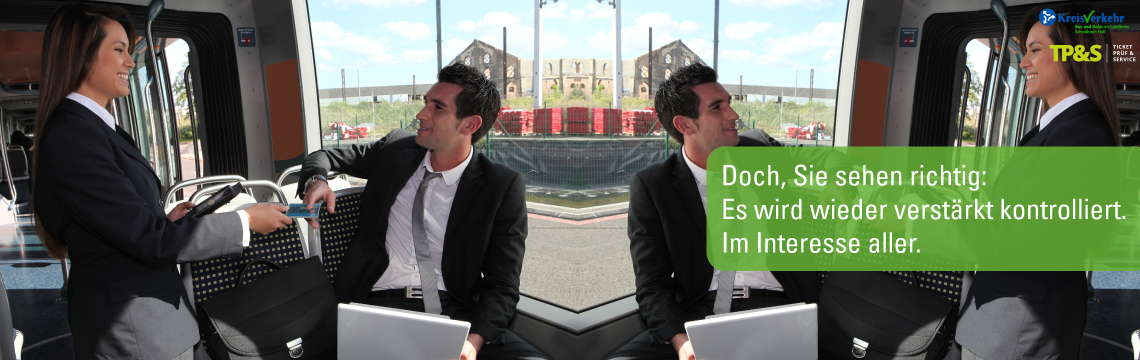
Attention: Ticket inspection!
We ask for your understanding and cooperation. Here we explain the reasons behind this decision.
Dear Passengers,
KreisVerkehr, together with the transit companies and the district administration, has decided to resume the ticket inspections that were suspended during the COVID-19 pandemic and the numerous changes associated with the KVSH fare reform, the JugendticketBW, the Deutschland-Ticket, and the D-Ticket JugendBW. These inspections are being conducted in cooperation with the inspection service provider TP&S.
Why monitor?
Ticket inspections serve various purposes. They are necessary solely to validate the tickets of all other passengers. After all, providing public transportation costs money, and ticket sales must contribute their share of the costs. If buses and trains operated on the assumption that the many passengers would voluntarily purchase tickets and allow them to be checked, buses and light rail would be like a supermarket without security cameras, relying on an “honesty box”: simply not viable. Ticket inspections are also intended to give passengers with season passes the feeling that it was worth buying the ticket. Another reason for electronic ticket inspections is “clearing”—that is, the distribution of revenue from the beneficiary customer to the transportation company providing the service.
Information about the (((eTicket
Who is in charge?
Ticket inspections are typically carried out by teams of two who travel daily to various parts of the KVSH network. There, they inspect approximately 30 vehicles as part of their workday. Working in pairs allows for flexibility, and the inspectors can look out for one another.
In addition, drivers can conduct inspections using barcode scanners and the NFC reader built into the onboard computer.
What happens to passengers without a valid ticket?
Anyone who doesn’t have a ticket but rides anyway is riding without a fare. If they are checked and found to be in violation, their information must first be recorded on the spot. After all, it must be clear who is (in the worst case, once again) fraudulently obtaining the service—to use the correct term. If the information cannot be recorded or is incorrect, the police are called to the next appropriate stop. Only after the passenger and the inspectors have gotten off can the bus continue on its way; after all, it has to stay on schedule. It would be frustrating for all passengers if a bus or train were also delayed because of a fare evader. A common point of confusion concerns the inspector’s rights: The inspector is authorized to detain the fare evader (Section 127 of the Code of Criminal Procedure, the so-called “everyman’s right”), since the fare evader is committing a criminal offense—until the police take over. The 60.00 euros that the fare evader must pay can either be paid at a KreisVerkehr Customer Center or transferred directly to TP&S. However, the increased fare can no longer be paid to the inspector directly, as they no longer carry cash registers for security reasons. If a valid pass that was valid at the time of the inspection was forgotten, it can be presented within seven days at the KVSH Customer Center in Schwäbisch Hall or Crailsheim, reducing the amount due to 7.00 euros.
This post is also available in: German

